ABSTRACTS
Paramedics Without Borders: Evaluating US Exam Success Among Australian CliniciansAuthor: Michael Kaduce MPS, NRP | Director | Falck Health Institute; University of Texas Health, San Antonio Associate Authors: Hums, Jason, MPH, BSN, NPR Wurtz, Dannie, RN, PM
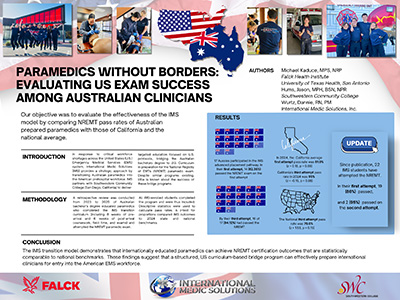
Background: In response to critical workforce shortages across the United States (US) Emergency Medical Services (EMS) system, International Medic Solutions (IMS) provides a strategic approach by transitioning Australian paramedics into the American prehospital workforce. IMS partners with Southwestern Community College (San Diego, California) to deliver targeted education focused on US protocols, legal standards, and preparation for the National Registry of EMTs (NREMT) paramedic exam. Despite similar programs existing, little is known about the success of these bridge programs. Our objective was to evaluate the effectiveness of the IMS model by comparing NREMT pass rates with those of California and the national average. Methods: A retrospective review was conducted from 2023 to 2025 of Australian bachelor's degree-educated paramedics who completed the IMS transition curriculum (including 8 weeks of pre-arrival and 6 weeks of post-arrival coursework, interviews, and exams) and attempted the NREMT paramedic exam. All IMS-enrolled students completed the program and were thus included. Descriptive statistics were used to calculate pass rates. A z-test for proportions compared IMS outcomes to 2024 state and national benchmarks. Results: Seventeen Aussies participated in the IMS advanced placement pathway. In their first attempt, 14 of 17 (82.35%) passed the NREMT exam, compared to a 2024 California average of 81.0% (z = 0.15, p = 0.88). By their third attempt, 16 of 17 (94.12%) had passed, similar to the California third attempt pass rate of 95% (z = -0.15, p = 0.88) and outperforming the national third attempt pass rate of 79.0% (z 1.53 =, p = 0.13). Conclusion: The IMS transition model demonstrates that internationally educated paramedics can achieve NREMT certification outcomes that are statistically comparable to national benchmarks. These findings suggest that a structured, US curriculum-based bridge program can effectively prepare international clinicians for entry into the American EMS workforce without compromising exam performance standards. This approach may serve as a viable and scalable strategy to address workforce gaps while maintaining regulatory and clinical integrity.
|