ABSTRACTS
Establishing an AMSA Analysis PlatformAuthor: Koshi Nakagawa | Assistant Professor | Department of Integrated Science and Engineering for Sustainable Societies, Faculty of Science and E Associate Authors:
Background and Objective
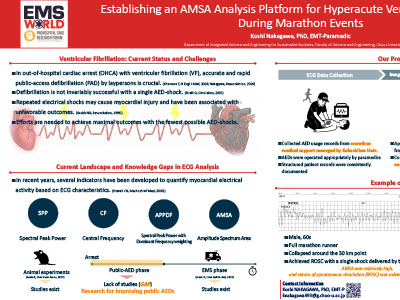
For out-of-hospital cardiac arrest with ventricular fibrillation (VF), prompt defibrillation is crucial for patient outcomes. Recently, the Amplitude Spectrum Area (AMSA) of VF has gained attention as a predictor of successful defibrillation, with higher AMSA values associated with greater defibrillation success. However, existing AMSA research is limited to animal studies and data from EMSs. There are no international reports on AMSA in "hyperacute" VF, which occurs when laypersons use an automated external defibrillator (AED). Methods and Future Prospects We used OpenCV in Python to perform image recognition on PDF-formatted AED records, digitizing and quantifying the ECG. Subsequently, we calculated AMSA using Fast Fourier Transform (analysis band: 4Hz-48Hz) for the 2-second ECG immediately preceding defibrillation (Fig. 1). Moving forward, we will build a registry that integrates the calculated AMSA with emergency records from the mobile AED team (e.g., age, time of cardiac arrest onset, time of defibrillation, and outcomes). This registry will enable more detailed analyses, such as the association between AMSA and patient outcomes. Furthermore, we aim to establish a multi-institutional collaborative registry with marathon emergency medical teams both domestically and internationally. This will allow for a larger-scale analysis of AMSA, with the ultimate goal of contributing to the optimization of defibrillation strategies in "hyperacute" VF >[IMAGE] Fig 1. Extracted electrocardiogram and AMSA
|