ABSTRACTS
Analyzing the Prehospital Treatment Effects of CPAP and BiPAPAuthor: Jerome Munna, Jr. BS, Paramedic | EMS Director | Brunswick Community College Associate Authors: Reyes, Luis G., AS, AAS, Paramedic | Houston, Sara E., MHS, NRP, NCEE | Kaplan, Ginny R., PhD, MHS, Paramedic, FAEMS | Hubble, Michael, W., PhD, MBAA, NRP
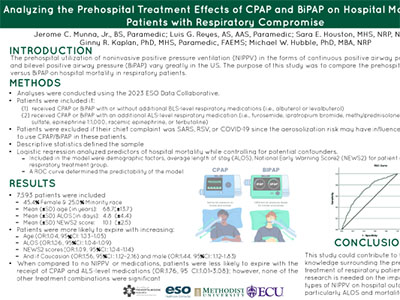
Introduction The prehospital utilization of noninvasive positive pressure ventilation (NIPPV) in the forms of continuous positive airway pressure (CPAP) and bilevel positive airway pressure (BiPAP) vary greatly in the US. The purpose of this study was to compare the prehospital use of CPAP versus BiPAP on hospital mortality in respiratory patients. Methods Analyses were performed using the 2023 ESO Data Collaborative. Patients with primary and secondary impressions of respiratory compromise were included and subsequently stratified into two NIPPV groups: (1) received CPAP or BiPAP with or without additional basic life support (BLS)-level respiratory medications (i.e., albuterol or levalbuterol); or (2) received CPAP or BiPAP with an additional advanced life support (ALS)-level respiratory medication (i.e., furosemide, ipratropium bromide, methylprednisolone, magnesium sulfate, epinephrine 1:1,000, racemic epinephrine and terbutaline). Patients were excluded if their chief complaint was SARS, RSV, or COVID-19 since the aerosolization risk may have influenced the decision to use CPAP/BiPAP in these patients. Descriptive statistics defined the sample, and a logistic regression analyzed predictors of hospital mortality while controlling for potential confounders. Included in the model were demographic factors, average length of stay (ALOS), National Early Warning Score2 (NEWS2) for patient acuity, and each respiratory treatment group. A ROC curve determined the predictability of the model. Results A total of 7593 patients met inclusionary criteria, of which 370 expired. Overall, 25.0% were minorities and 45.4% were female. Mean(±SD) age, ALOS, and NEWS2 scores were 68.7±13.7, 4.8±4.4, and 10.1±2.5, respectively. Patients were more likely to expire with increasing age (OR:1.04, 95%CI: 1.03–1.05), ALOS (OR:1.06, 95%CI:1.04–1.09), NEWS2 scores (OR:1.09, 95%CI:1.04–1.14), and if Caucasian (OR:1.56, 95%CI:1.12–2.16), and male (OR:1.44, 95%CI:1.12–1.83). When compared to no NIPPV or medications, patients were less likely to expire with the receipt of CPAP and ALS-level medications (OR:1.76, 95%CI:1.01–3.08); however, none of the other treatment combinations were significant. The ROC curve showed good predictability at 0.70. Conclusion s
|