ABSTRACTS
Predictive Analysis of Demand for Emergency Medical Services 9-1-1 in Costa RicaAuthor: Andres Cairol MD | Principal Investigation | UNIBE Associate Authors: Carlos Mora, MSc, UTN | Luis Felipe Loaiza, MD, UNIBE | Wendy Morun, MD, UNIBE | Dorian Chaves, Eng, UTN
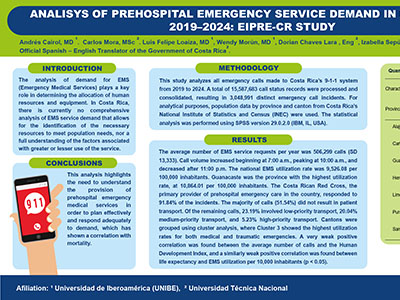
Introduction The investigation of historical evidence through numerical techniques and machine learning permits the recognition of patterns in the service demand of the 9-1-1 Emergency System. This evidence-based approach aids in the decision-making process by anticipating beforehand demand and honing in on existing resources. Methodology: From 2019 to 2024, the 9-1-1 Emergency System received a total of 3,048,991 calls, of which 92% were for pre-hospital care, with the Costa Rican Red Cross being its main provider. This demand was contemplatively studied utilizing descriptive statistical tactics. Additionally, an ARIMA model was used for time series scrutiny, employing SPSS software. Results: Between 2019 and 2024, the 9-1-1 Emergency System received a total of 3,048,991 calls, with a monthly median number of 40,419 (SD 2002.17) and a monthly variation of 4.88%. Nationwide, there were 15,924 priority 1 dispatches (5.23%), 611,094 priority 2 dispatches (20.04%), and 707,043 priority 3 dispatches (23.19%). Furthermore, 51.54% of the dispatches (1,571,430) were classified as priority 4, requiring no transfer to a medical center. The ARIMA model used for time series analysis showed a stationary termination coefficient (stationary R²) of 0.435, indicating that the model explains approximately 43.5% of the variability in the time series. The model's accuracy was reflected by a mean absolute error (MAE) of 68.95 units and a mean absolute percentage error (MAPE) of 4.93%. The Ljung-Box Q(18) statistic was significant (χ² = 141.48, df = 13, p < 0.001), confirming the absence of autocorrelation in the residuals. The root mean square error (RMSE) was 91.53 units. In accordance with predictions of the ARIMA model, 498,788 calls are anticipated for 2025, representing an increase of 7,193 calls compared to 2024. The projected daily average of calls is 1,366 (SD = 63.27). Discussion: Several EMS systems have used prediction models for daily call forecasting, utilizing tools like ARIMA, providing robust models. Conclusions This daily call prediction model for the EMS permits early acquisition of data necessary to plan timely care and ultimately lays the groundwork for further studies that consider external variables to this service.
|