ABSTRACTS
HEART-score in the prehospital settingAuthor: Nancy van der Waarden MSc. | Nurse practitioner emergency care/ Clinical epidemiologist/ PhD candidate | Ambulance service Rotterdam Rijnmond Associate Authors: van der Waarden, Nancy, WPL, MSc. | van Dijk, Mats, MSc. | Backus, Barbra, E, Dr.
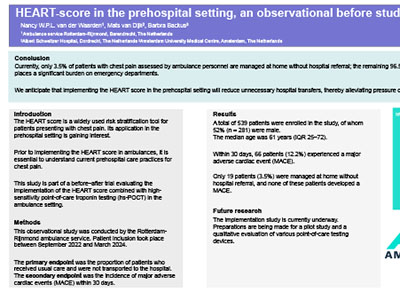
Introduction Worldwide the HEART-score is a widely used risk assessment tool in patients with chest pain. The use of the HEART-score is upcoming in the prehospital setting. Before implementation of the HEART-score it is necessary to gain information on the usual care of patients with chest pain in the prehospital setting. Therefore, the current study is part of a before-after trial on the implementation of the HEART-score with a high sensitive Point Of Care Troponin (hs-POCT) in the ambulance. Methods This observational study was performed by the ambulance service of Rotterdam-Rijnmond. Patients were included from September 2022 until March 2024. The primary endpoint was the percentage of patients left at home with usual care by the ambulance personal. Secondary endpoint was the percentage Major Adverse Cardiac Event (MACE) after 30 days. Results In this study 539 patients were enrolled, 52% was male (281). Median age was 61 ± 25-72 (median ± IQR). In total 66 patients developed a MACE within 30 days. Only 19 patients (3.5%) were left at home (without hospital referral), no MACEs were missed in these patients. Conclusion Without the use of the HEART score only 3,5% of patients with chest pain seen by the ambulance are left at home, the remaining 96.5% of patients are transferred to the hospital for further evaluation. This is an enormous burden for emergency departments. We foresee an increase in patients who do not need further hospital evaluation when implementing the HEART-score in the prehospital setting.
|