ABSTRACTS
Efficacy on Patient Outcomes between Using Private and Public Emergency Medical Services (EMS) Transporting Emergency Patients to the Emergency DepartmentAuthor: Parama Kaninworapan PMD | | Division of Paramedicine, Department of Emergency Medicine, Faculty of Medicine Ramathibodi Hospit Associate Authors: Jenpanitpong,Chetsadakon,PMD.Ph.D | Nuanprom,Promphet, PMD.Ph.D | Aramvanitch,Kasamon,MD.FTCEP.
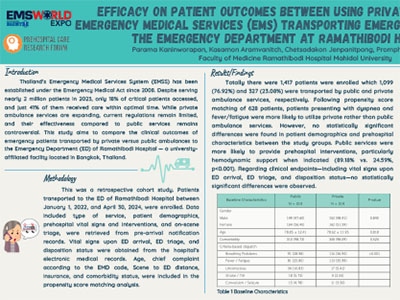
Background Thailand’s Emergency Medical Services System (EMSS) has been established under the Emergency Medical Act since 2008. Despite serving nearly 2 million patients in 2023, only 18% of critical patients accessed, and just 41% of them received care within optimal time. While private ambulance services are expanding, current regulations remain limited, and their effectiveness compared to public services remains controversial. This study aims to compare the clinical outcomes of emergency patients transported by private versus public ambulances to the Emergency Department (ED) of Ramathibodi Hospital — a university-affiliated facility located in Bangkok, Thailand. Results Totally there were 1,417 patients were enrolled which 1,099 (76.92%) and 327 (23.08%) were transported by public and private ambulance services, respectively. Following propensity score matching of 628 patients, patients presenting with dyspnea and fever/fatigue were more likely to utilize private rather than public ambulance services. However, no statistically significant differences were found in patient demographics and prehospital characteristics between the study groups. Public services were more likely to provide prehospital interventions, particularly hemodynamic support when indicated (89.18% vs. 24.59%, p<0.001). Regarding clinical endpoints—including vital signs upon ED arrival, ED triage, and disposition status—no statistically significant differences were observed. Conclusion No differences in ED clinical outcomes were observed between private versus public ambulance services. However, public services were more likely to provide prehospital interventions when indicated. These findings highlight the potential value of integrating private ambulance services into Thailand EMSS.
|