ABSTRACTS
Prehospital Emergency Care with Realtime Tele-Medical Oversight vs. Traditional Online Medical Oversight: An 11-Year Retrospective Cohort Study.Author: Chaiyaporn Yuksen | Doctor | Department of Emergency Medicine, Faculty of Medicine, Ramathibodi Hospital, Mahidol University Associate Authors: Chaiyaporn Yuksen | Malivan Phontabtim | Satariya Trakulsrichai | Pungkava Sricharoen | Kasamon Aramvanich | Welawat Tienpratarn | Siriporn Damdin | Suteenun Seesuklom | Natthaphong Thiamdao | Chantarat Palee
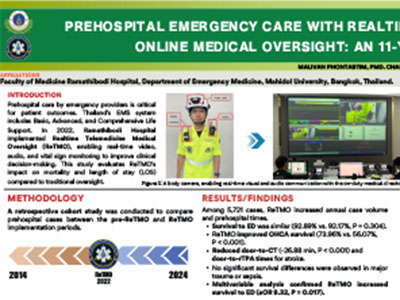
Introduction The Realtime Tele-Medical Oversight (ReTMO) framework combines telemedicine with real-time monitoring of on-scene operations, direct online medical orders, and coordinated patient care. This study evaluates its effectiveness compared to traditional online medical oversight by analyzing patient mortality and length of stay (LOS) in the emergency department (ED), hospital, and intensive care unit (ICU). Methods This retrospective cohort study evaluated the effectiveness of the ReTMO protocol in the Emergency Medical Operation (EMO) Unit of Ramathibodi Hospital by comparing outcomes between the pre-ReTMO (2014–2021) and ReTMO (2022–2024) periods. Multivariable regression analysis was employed to assess the impact of ReTMO on patient outcomes. Results This 11-year retrospective cohort study analyzed 5,721 prehospital emergency cases, comprising 3,398 cases in the pre-ReTMO period and 2,323 cases during the ReTMO period. The findings indicate that the implementation of the ReTMO protocol significantly improved overall survival to the ED (aOR: 8.32, 95% CI: 1.47–47.14, P=0.017), particularly for out-of-hospital cardiac arrest (OHCA) patients (aOR: 7.99, 95% CI: 1.28–50.03, P=0.026). However, the protocol did not result in significant improvements in survival to hospital admission or discharge. Furthermore, the LOS in the ED, ICU, and overall hospital stay remained unchanged. Conclusions The ReTMO protocol has significantly enhanced overall ED survival, particularly in OHCA patients. The protocol has led to an increased utilization of invasive prehospital procedures. However, the LOS in the ED, ICU, and overall hospital stay remained unchanged.
|