ABSTRACTS
System-Wide Implementation of the RespiratoryAuthor: Michael Kaduce MPS, NRP | Director | Falck Health Institute; University of Texas Health, San Antonio Associate Authors: Raj, Vishal, MA, EMT | Tseng, Jonathan, BA, EMT | Ryan, Shane, EMT
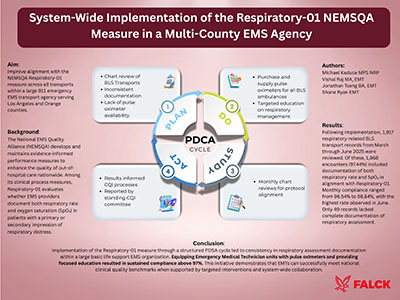
Background The National EMS Quality Alliance (NEMSQA) develops and maintains evidence-informed performance measures to enhance the quality of out-of-hospital care nationwide. Among its clinical process measures, Respiratory-01 evaluates whether EMS providers document both respiratory rate and pulse oximetry (SpO ₂) in patients with a primary or secondary impression of respiratory distress. Consistent implementation of this measure can be challenging in basic life support (BLS) systems, where access to equipment and standardized documentation practices may vary. The objective of this project was to improve compliance with the Respiratory-01 measure across all transports within a large 911 emergency EMS transport agency serving Los Angeles and Orange counties. Methods A Plan–Do–Study–Act (PDSA) cycle was employed to enhance compliance with the NEMSQA Respiratory-01 measure. During the Plan phase, a review of BLS transport records revealed inconsistent documentation and limited access to pulse oximeters. The Do phase included the system-wide purchase and deployment of pulse oximeters, as well as targeted education for EMTs on equipment use, recognition of respiratory distress, and the importance of documenting both respiratory rate and SpO ₂. During the Study phase, a monthly chart review was conducted each month after implementation. In the Act phase, findings informed ongoing quality assurance feedback and CQI processes. Results Following implementation, 1,917 BLS transport records from March through June 2025 were reviewed. Of these, 1,868 encounters (97.44%) included documentation of both respiratory rate and SpO ₂ in alignment with Respiratory-01. Monthly compliance ranged from 96.54% to 98.84%, with the highest rate observed in June. Only 49 records lacked complete respiratory assessment documentation. Chart reviews of these records are ongoing. Conclusion Implementation of the Respiratory-01 measure through a structured PDSA cycle led to a substantial improvement in respiratory assessment documentation within a large basic life support EMS organization. Equipping Emergency Medical Technician units with pulse oximeters and providing focused education resulted in sustained compliance above 97%. This initiative demonstrates that EMTs can successfully meet national clinical quality benchmarks when supported by targeted interventions and system-wide collaboration.
|