ABSTRACTS
Investigation of the Association Between Electric Lift Chair and Physical Burden During Stairs Patient TransportAuthor: Ryu Kimura MEM, EMT-Paramedic | PhD student | Graduate School of Emergency Medical System, Kokushikan University Associate Authors: Koshi Nakagawa, PhD, EMT-P | Akira Takahashi, EMT-P | Masaya Tanaka, MEM, EMT-P | Hinata Kijima, MEM, EMT-P | Hatsumi Yanagisawa, EMT-P | Hiroto Harayama, EMT-P | Ryosuke Shibuya, EMT-P | Konosuke Shimizu, EMT-P | Yamato Abe, EMT-P | Hideharu Tanaka, MD, PhD
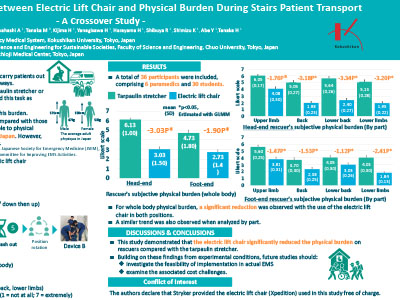
Background In Japan, the number of patients transported by ambulance has been increasing annually, reaching 6,641,420 in 2023. A nationwide survey on the physical and psychological burden on EMS personnel in Japan revealed that 51.5% of male paramedics and 29.4% of female paramedics cited stair transport as a burdensome activity. Consequently, measures to alleviate the physical burden on EMS personnel during stair transport are required. An electric lift chair has been developed, but its usefulness has not yet been sufficiently validated. Objective This study aimed to compare the subjective physical burden of using an electric lift chair or a tarpaulin stretcher during patient transport on stairs. Methods A crossover simulation study was conducted with a total of 36 participants, comprising 6 paramedics and 30 paramedic students. Participants were divided into groups of three (rescuer at the head-end, rescuer at the foot-end, and simulated patient). The order of equipment use and the route (up then down, or down then up) were randomized, and simulated patients were transported up and down two floors of stairs. The primary outcome was the subjective physical burden reported by the rescuers immediately after transport, measured using a 7-point Likert scale (1 = not burdensome at all; 7 = extremely burdensome). Generalized linear mixed models were used for statistical analysis. Results The mean subjective physical burden for each group was 3.03 (head-end) and 2.73 (foot-end) for the electric lift chair, and 6.13 (head-end) and 4.73 (foot-end) for the tarpaulin stretcher. The electric lift chair demonstrated a significantly lower physical burden compared to the tarpaulin stretcher (β [95% CI]; head-end, -3.03 [-3.54, -2.52]; foot-end, -1.90 [-2.51, -1.29]). Conclusion The electric lift chair significantly reduced the physical burden on rescuers compared to the tarpaulin stretcher. The results of this study suggested the electric lift chair may serve as an effective intervention to alleviate the physical burden on EMS personnel during patient transport on stairs.
|