ABSTRACTS
Exploring the impact of frequent callers on ambulance care: A Mixed-Methods Study in the Rotterdam-RijnmondAuthor: Natalie Van Loon-Lagerweij MSc | Nurse Practitioner Ambulanceservice Rotterdam Rijnmond | Ambulanceservice Rotterdam Rijnmond Associate Authors: van Bruchem, Ada, GG, dr | van der Waarden, Nancy, WPL, MSc
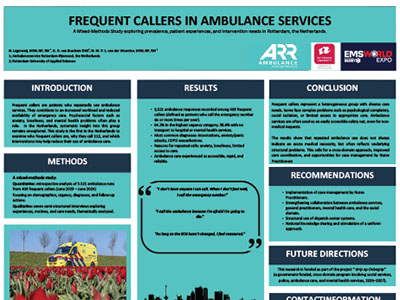
Aim This study aims to examine the scope, experiences, and expectations of frequent callers in the Rotterdam-Rijnmond region and identify factors and interventions that may reduce their use of prehospital emergency care. Method Between June 1, 2023 and June 1, 2024, a retrospective quantitative analysis was performed using ambulance records of 403 frequent callers, who collectively generated 3,521 ambulance responses. The analysis focused on demographic characteristics, dispatch details, urgency classification, working diagnoses, and follow-up actions. Seven semi-structured interviews underwent thematic analysis. Findings Of the 3,521 ambulance dispatches, 64.2% were classified as A1 urgency, while 38.6% did not result in transport to a healthcare facility. In these cases, care was mainly provided on site (16.3%), followed by referral to a general practitioner (4.6%). The most frequently recorded working diagnoses were intoxications, COPD exacerbations, anxiety and panic attacks, and acute coronary syndrome. The qualitative analysis indicated that repeated use of ambulance care is associated with psychosocial factors such as social isolation and psychological problems, as well as perceived barriers in access to appropriate care. Discussion The findings provide insight into the recurrent use of ambulance care by frequent callers, including in situations where acute medical problems are not the sole reason for contact. Anxiety, uncertainty, social isolation, and limited access to regular healthcare services play a role. Ambulance care is perceived by respondents as a low-threshold and reliable form of help, especially when alternative sources of care, such as general practitioner services or crisis teams, are experienced as difficult to access. These findings are consistent with international literature that advocates for multidisciplinary collaboration and improved care coordination. Conclusion This is, as far as known, the first systematic study in the Netherlands that provides insight into frequent callers within ambulance care. Frequent callers represent a vulnerable patient group with complex and partly non-medical care needs. Ambulance care frequently functions as a first point of contact. There is a need for cross-sectoral and effective interventions that better align with the needs of this population.
|