ABSTRACTS
Prehospital Respiratory Support in Pregnant PatientsAuthor: Rihi Jain MPH, EMT-B | EMT | Rutgers School of Public Health Associate Authors: Sabani, Albiona, BS EMT-P | Monti, Christopher, E, PhD | Phelan, Mary Beth, MD | DeFilippo, Michael, DO | McGurk, Kevin, MD | Rollman, Jeffrey, E, MPH, NRP
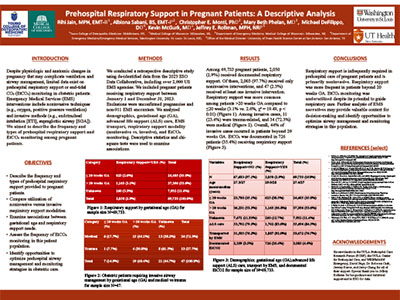
Introduction Despite physiologic and anatomic changes in pregnancy that may complicate ventilation and airway management, limited data exist on prehospital respiratory support or end-tidal CO ₂ (EtCO ₂) monitoring in obstetric patients. Emergency Medical Services (EMS) interventions include noninvasive techniques (e.g., oxygen, positive pressure ventilation) and invasive methods (e.g., endotracheal intubation [ETI], supraglottic airway [SGA]). We aimed to describe the frequency and types of prehospital respiratory support and EtCO ₂ monitoring among pregnant patients. Methods We conducted a retrospective descriptive study using de-identified data from the 2023 ESO Data Collaborative, including over 2,000 US EMS agencies. We included pregnant patients receiving respiratory support between January 1 and December 31, 2023. Exclusions were unconfirmed pregnancies and non-911 EMS encounters. We analyzed demographics, gestational age (GA), advanced life support (ALS) care, EMS transport, respiratory support modality (noninvasive vs. invasive), and EtCO ₂ monitoring. Descriptive statistics and chi-square tests were used to examine associations. Results Among 69,733 pregnant patients, 2,050 (2.9%) received documented respiratory support. Of these, 2,003 (97.7%) received only noninvasive interventions, and 47 (2.3%) received at least one invasive intervention. Respiratory support was more common among patients >20 weeks GA compared to ≤20 weeks (3.1% vs. 2.6%, χ² = 19.49, p < 0.01). Among invasive cases, 11 (23.4%) were trauma-related, and 34 (72.3%) were medical. Overall, 44% of invasive cases occurred in patients beyond 20 weeks GA. EtCO ₂ was documented in 726 patients (35.4%) receiving respiratory support. Conclusion Respiratory support is infrequently required in prehospital care of pregnant patients and is primarily noninvasive. Respiratory support was more frequent in patients beyond 20 weeks GA. EtCO ₂ monitoring was underutilized despite its potential to guide respiratory care. Further analysis of EMS narratives may provide valuable context for decision-making and identify opportunities to optimize airway management and monitoring strategies in this population.
|