ABSTRACTS
HOV Risk Retrospective: A Decade of High Occupancy Vehicle CrashAuthor: Ian Lechevet MPH, MSW, NRP | CQI Manager | Lancaster Volunteer Ambulance Corp Associate Authors: Capollari, Mikel, BASc, EMS I/C, CCP-C | Bleau, Alexander, EMT | Kaur, Parneet, MS | Abo, Benjamin, N, DO, NRP
Intro High-occupancy vehicle (HOV) crashes pose significant challenges to Emergency Medical Services (EMS) due to their potential to escalate into mass casualty incidents. This study focuses on vehicles with nine or more occupants, excluding traditional high-capacity consumer vehicles. HOV crashes have posed unique response challenges for much of the past century; however, data on injury severity, fatality patterns, and their overall impact remain limited. This study aims to identify trends in fatal HOV incidents and enhance EMS planning and response.
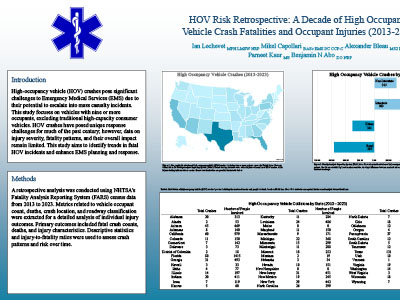
Methods A retrospective analysis was conducted using NHTSA’s Fatality Analysis Reporting System (FARS) census data from 2013 to 2023. Metrics related to vehicle occupant count, deaths, crash location, and roadway classification were extracted for a detailed analysis of individual injury outcomes. Primary outcomes included fatal crash counts, deaths, and injury characteristics. Descriptive statistics and injury-to-fatality ratios were used to assess crash patterns and risk over time. Results Between 2013 and 2023, 878 HOV crashes were reported, with a mean of 17.06 occupants per vehicle (SD = 10.96; Q1 = 9.75, Q3 = 20.37). Among these, 462 involved at least one HOV occupant fatality, averaging 2.13 deaths per crash (SD = 1.97; Q1 = 1.0, Q3 = 2.79). Fatal crashes also resulted in 541 uninjured individuals, 1,106 possible injuries, 1,983 minor injuries, and 1,618 serious injuries. Estimated injury risks per occupant were 0.55 (no injury), 1.12 (possible), 2.02 (minor), and 1.64 (serious). Most fatal HOV crashes occurred in rural (64.6%) and non-interstate (64.1%) settings. Conclusion HOV crashes resulting in fatality impose a significant injury burden, with both minor and serious injuries occurring nearly twice as frequently per occupant. Most incidents occur in rural areas where resources are limited, emphasizing the necessity for specialized EMS planning that focuses on rapid triage and scalable resource deployment. By understanding the ratios of injuries to fatalities, we can work to reduce injury and mortality rates. Further research is needed to evaluate the influence of individual differences on outcomes associated with HOV crashes.
|