ABSTRACTS
Signals in the Silence: EMS Response VolumeAuthor: Michael Kaduce MPS, NRP | Director | Falck Health Institute; University of Texas Health, San Antonio Associate Authors: Raj, Vishal MA, EMT | Hanson, Lyle | Nguyen, Peter, NRP
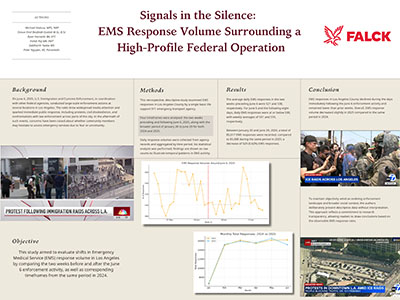
Background On June 6, 2025, U.S. Immigration and Customs Enforcement, in coordination with other federal agencies, conducted large-scale enforcement actions at several locations in Los Angeles. The raids drew widespread media attention and sparked immediate public response, including protests, civil disobedience, and confrontations with law enforcement across parts of the city. In the aftermath of such events, concerns have been raised about whether community members may hesitate to access emergency services due to fear or uncertainty. This study aimed to evaluate shifts in Emergency Medical Service (EMS) response volume in Los Angeles by comparing the two weeks before and after the June 6 enforcement activity, as well as corresponding timeframes from the same period in 2024. Methods This retrospective, descriptive study examined EMS responses in Los Angeles by a single basic life support 911 emergency transport agency. Four timeframes were analyzed: the two weeks preceding and following June 6, 2025, along with the broader period of January 20 to June 29 for both 2024 and 2025. Daily response and transport volumes were collected from agency records and aggregated by week and month. No statistical analysis was performed; findings are shown as raw counts to illustrate temporal patterns in EMS activity. Results The average daily EMS responses in the two weeks preceding June 6 were 365 and 375, respectively. For June 6 and the following four days, daily EMS responses were at or below 360, with weekly averages of 361 and 368. Between January 20 and June 29, 2025, a total of 84,579 EMS responses were recorded, compared to 83,509 during the same period in 2024; an increase of 1,070 (1.28%) EMS responses. Conclusion EMS responses in Los Angeles declined during the days immediately following the June 6 enforcement activity and remained lower than prior weeks. Overall, EMS response volume increased slightly in 2025 compared to the same period in 2024. To maintain objectivity amid an evolving enforcement landscape and broader social context, the authors deliberately present descriptive data without interpretation. This approach reflects a commitment to research transparency, allowing readers to draw conclusions based on the observable EMS response rates.
|